What Happens On A Ningaloo Whale Shark Swim: The Day Hour By Hour
A Ningaloo whale shark swim runs on a rhythm set by the marine park rules: an early pickup, two reef snorkels while a spotter plane hunts, then short jumps beside the biggest fish in the sea. Here is how the whole day unfolds.
Short answer
A Ningaloo whale shark swim day starts about 7:00 am with pickup, runs two inner-reef snorkels while spotter planes search, then puts swimmers in the water in groups of up to ten, with repeated jumps, a late lunch and a return by about 4:00 to 5:00 pm. Swim interaction is capped at 60 minutes and swimmers stay 3 m from the head and 4 m from the tail.
A Ningaloo whale shark swim is not a beach encounter you wander into. It is a licensed, tightly choreographed day on the water, run by operators permitted by the Department of Biodiversity, Conservation and Attractions (DBCA), and it follows a shape the regional tourism body describes almost identically across operators: leave accommodation about 7:00 am, two inner-reef snorkels while spotter planes search offshore, short swims beside the shark in controlled groups, a late lunch, back at the ramp by 4:00 to 5:00 pm. For the days you would rather stay near shore, our plain guide to swimming at Exmouth's beaches covers Bundegi, Town Beach and Turquoise Bay, along with currents, stingers and water temperatures.
That shape matters when you are choosing between tours, because the differences between them are smaller than the price spread suggests. The Ningaloo Blue swim from Exmouth, the Coral Bay Ecotours Whale Shark Safari and the Ningaloo Marine Interactions odyssey out of Coral Bay all work to the same interaction protocol. What changes is the town you leave from, whether pickup is offered, the group size on board and how long the boat is out. This guide walks the day from the first knock at your accommodation door to the moment you step back onto the ramp, with the official rules that shape each stage, so you know exactly what you are buying. Whale Shark Tours Exmouth keeps this page focused on the day itself; for choosing between operators, the Exmouth versus Coral Bay comparison is the companion read.
What Happens On A Ningaloo Whale Shark Swim Day?
A full-day Ningaloo whale shark swim runs roughly 7:00 am to 4:00 or 5:00 pm: a transfer from your accommodation to the boat ramp, a safety and gear briefing, two guided inner-reef snorkels while a spotter plane searches offshore, then repeated short jumps beside a whale shark in groups of up to ten with a guide, a late lunch and the cruise home. The exact order flexes with the sharks and the sea.
The day pattern comes straight from the regional tourism body, Australia's Coral Coast, which documents the standard itinerary operators across both towns follow. It is worth internalising before you book, because almost every "what is it actually like" question people ask is answered by the structure itself. You are not floating beside a shark for hours. You are on a boat for most of the day, in the water for short bursts, and the crew is working the whole time: radioing the spotter plane, reading the current, timing the drop so the boat comes ahead of the shark's direction of travel, and counting swimmers in and out of the water.
The rhythm also explains the price. Whale shark swims on this site run from A$700 to A$745 per person, and what that buys is a spotter plane or a share of one, a licensed crew, gear, catering and a full day of fuel and boat time. A cheaper way to be in Ningaloo's water exists, and it is worth naming: the Cape Immersion six-hour boat snorkel from Exmouth from A$275 per person gets you the reef and its wildlife without the shark-hunting aircraft. The full swim day is a different product with a different cost base.
The Morning: Pickup, Gear And The Briefing
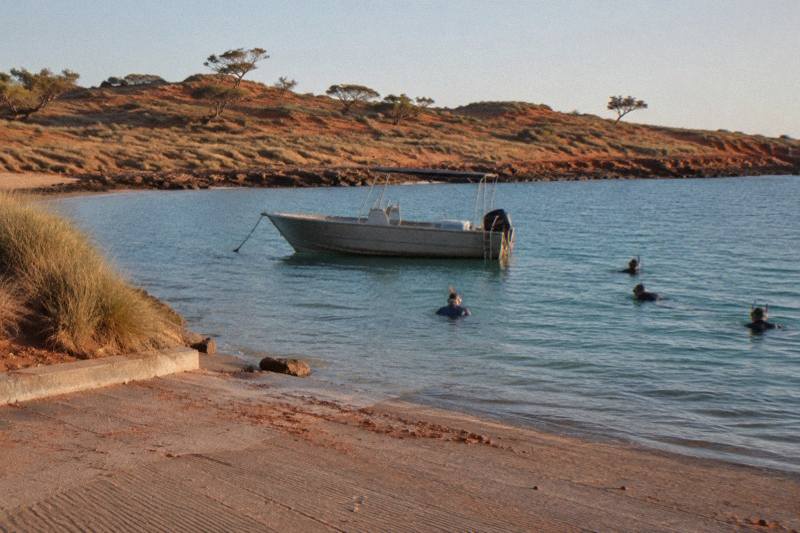
The morning runs early and fast: pickup from accommodation or a meeting point about 7:00 am, a short transfer to the boat ramp, wetsuit and snorkel gear fitted on board or at the shop, and a safety briefing that covers the swim rules before the boat leaves the ramp. Tours from Exmouth often offer hotel pickup, while several Coral Bay departures ask guests to meet at a stated point in town.
Pickup is one of the sharpest dividing lines in the roster, and it is worth checking before you book rather than assuming. The Ningaloo Blue swim from Exmouth offers pickup and departs from Tantabiddi Boat Ramp or collects from hotels, which removes the need for a morning drive. The Ningaloo Marine Interactions odyssey from Coral Bay does not offer pickup on its listing and asks guests to meet at 13/67 Robinson St. Coral Bay Ecotours' Whale Shark Safari likewise lists a meeting point in Coral Bay rather than pickup. None of this is a mark against a tour; Coral Bay is small enough that a meeting point is a five minute walk from most beds.
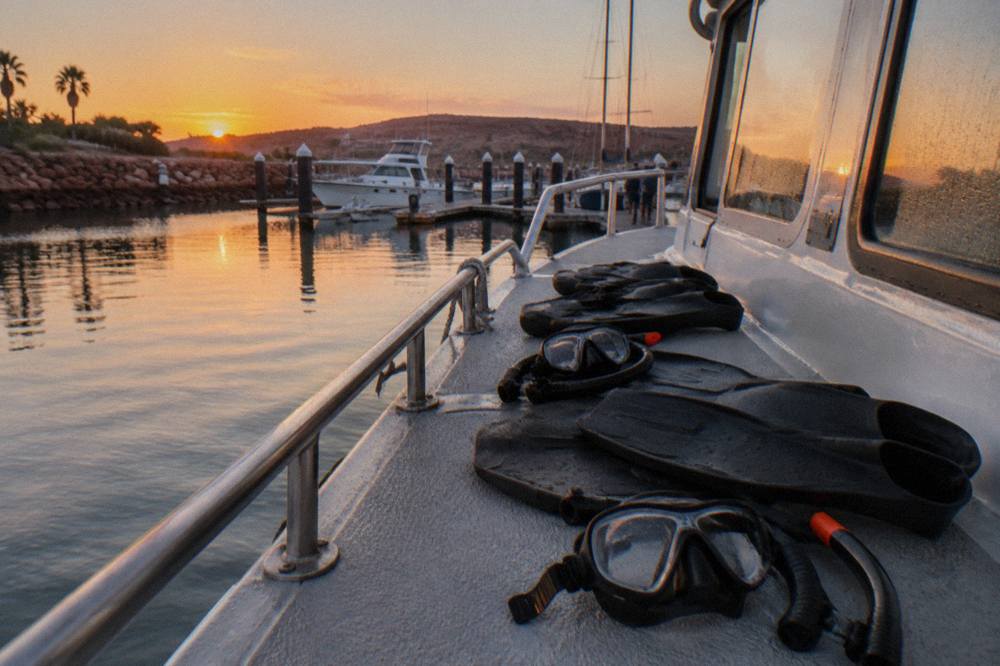
Gear comes next. Ningaloo Blue lists wetsuits and snorkel gear; check each Coral Bay swim listing for what's included. The suit is not optional. Sea surface averages around 28 degrees in April, the warmest month, but drop to about 23 degrees by August and September once the season runs into its shoulder. You will be in and out of the water repeatedly across six to nine hours, and heat drains differently on the tenth jump than on the first.
The briefing is where the day's legal framework lands on you as a swimmer. Crews walk through the DBCA interaction protocol, the three metre and four metre distances, the ten swimmer limit, no touching, no flash, no extension poles, and they explain how the drop works: the boat positions ahead of the shark's line of travel, you enter the water quickly when told, and a guide swims with your group. If any of that sounds intimidating, the paired question of swimming ability is covered in detail in do you need to be a strong swimmer.
Two Inner-Reef Snorkels While The Spotter Plane Searches
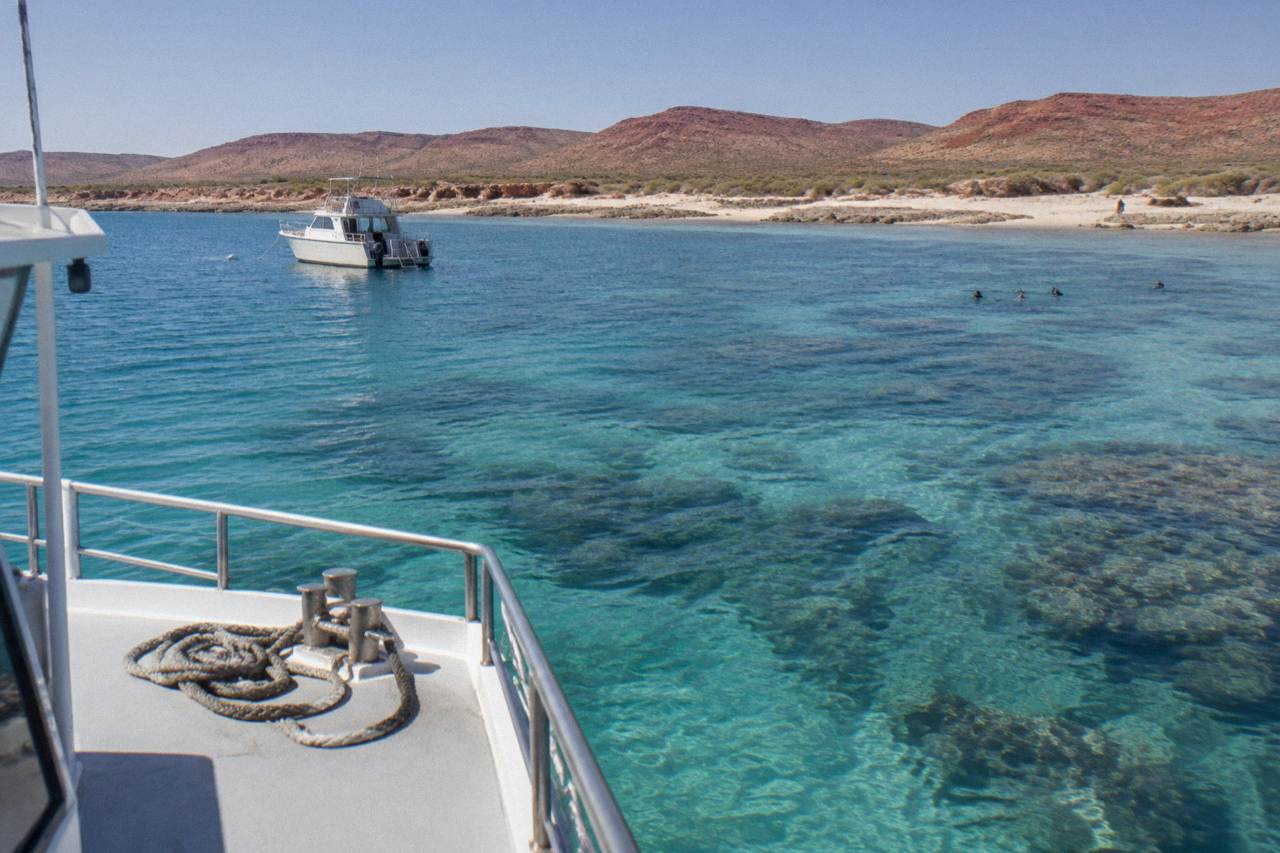
Almost every Ningaloo whale shark day includes two guided inner-reef snorkels before the shark swimming starts, run while a spotter plane or shared aircraft searches the outer reef for sharks. The snorkels serve as a warm-up, a swim ability check for the crew, and a genuine reef experience in their own right, since Ningaloo's fringing reef sits close to shore in shallow, protected water. If you're bringing kids along, that swim check is exactly where age limits and swimming expectations come into play, and the guide to children joining Ningaloo whale shark tours spells out what each operator actually requires.
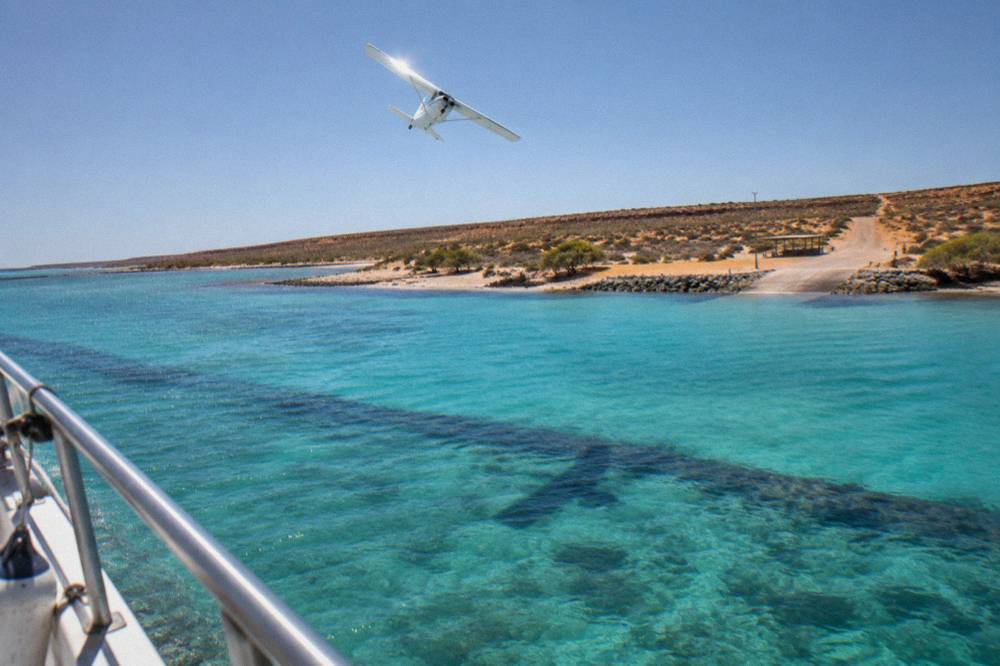
The spotter plane is the engine of the day and the single biggest cost in it. Light aircraft fly grid patterns over the outer reef, radioing positions to the boats below, and the boats hold their passengers busy and useful meanwhile: snorkelling the lagoon, drifting over coral, watching turtles and reef fish. The Australia's Coral Coast description of the standard day names this sequence explicitly, two reef snorkels while the planes search, and it holds across the Exmouth and Coral Bay operators alike. The spotter plane question gets its own treatment elsewhere on this site, but the short version is that aerial spotting is permitted under the official protocol and is how licensed commercial tours find sharks efficiently.
The warm-up snorkel is also a quiet assessment. Crews watch how guests handle open water, and it informs how they group swimmers for the shark drops. Nobody is asked to race anyone; the point is confidence, not speed. For swimmers who want more reef time than a whale shark day allows, or who are travelling with people who would rather skip the shark hunt entirely, a dedicated reef day is the honest answer: the Exmouth Adventure Co guided Ningaloo Reef snorkel from A$250 per person, or Cape Immersion's turtle snorkel from A$145 per person, both run from Exmouth with pickup offered and put reef time at the centre rather than around the edges. And if the crocodile question has crossed your mind, our plain answer on crocodiles at Ningaloo Reef covers what's actually documented there season by season, plus the tours that keep snorkellers safe in the water.
| Day stage | Typical time | What is happening |
|---|---|---|
| Pickup or meeting point | About 7:00 am | Transfer to the boat ramp, gear issue |
| Inner-reef snorkel one | Mid morning | First guided snorkel while the plane searches |
| Inner-reef snorkel two | Late morning | Second snorkel, reef wildlife, crew assesses swimmers |
| Shark swimming | Around midday onward | Repeated jumps in groups of up to ten, 60 minute interaction cap |
| Late lunch | After the swims | Meal served on board, most tours state catering on the listing |
| Cruise home | Afternoon | Return to the ramp by about 4:00 to 5:00 pm |
The Drop: Groups Of Ten And The Jump
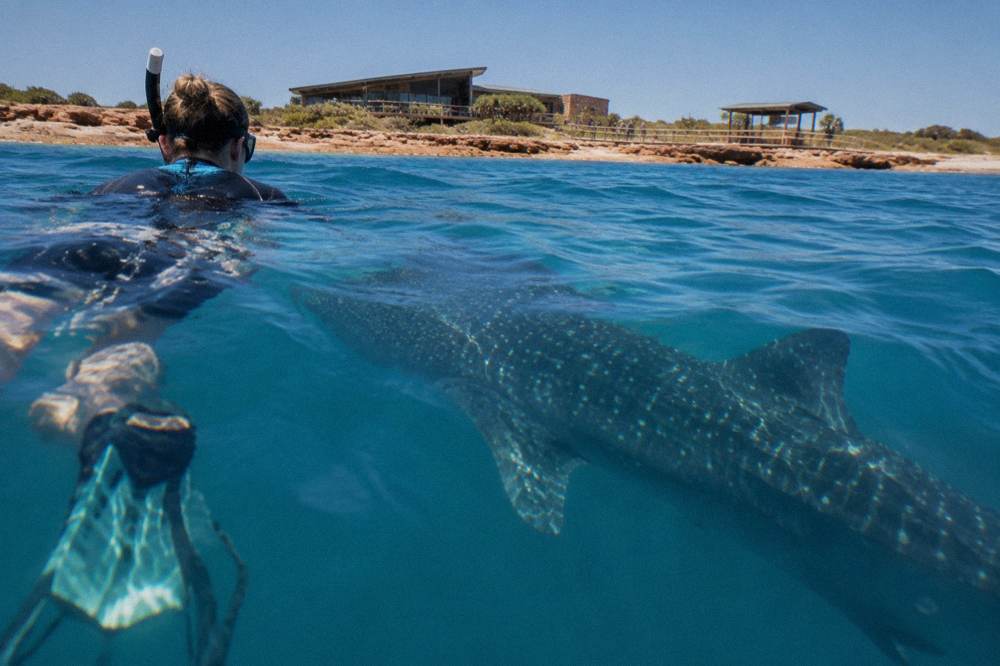
When a shark is located, the boat positions ahead of its direction of travel and drops swimmers in groups of up to ten with a guide in the water; each group swims briefly beside the shark, then the boat resets and the rotation repeats. Swimmers must stay at least 3 m from the head and body and 4 m from the tail, and no more than ten people may be in the water at once.
The drop is the moment the whole day is built around, and it is faster and less dramatic than most first-timers imagine. You sit on the swim step, the crew calls the moment, and you enter the water as the shark swims toward and then past your group. The guide sets the line, the shark does the moving, and a single jump typically gives you a stretch of fin beats and the enormous silhouette resolving out of the blue. Then the shark pulls ahead or the boat resets, you climb back aboard, and the rotation continues.
The rules that govern those minutes are legislated, not house policy. DBCA's swimmer protocol limits the water to ten people at a time, bans touching or riding, bans flash photography and cameras on poles, bans motorised propulsion aids, and sets the three and four metre approach distances. There is a second, vessel-side protocol: one boat at a time within a 250 m approach zone, a maximum of 90 minutes with any shark, speeds held to 6 knots or less inside the zone, and no vessel closer than 30 m. Commercial boats fly a whale shark flag plus dive flags while swimmers are in the water. The full rule set, including the 60 minute cap, is unpacked in the swim rules guide, and the official source is the DBCA whale shark management page.
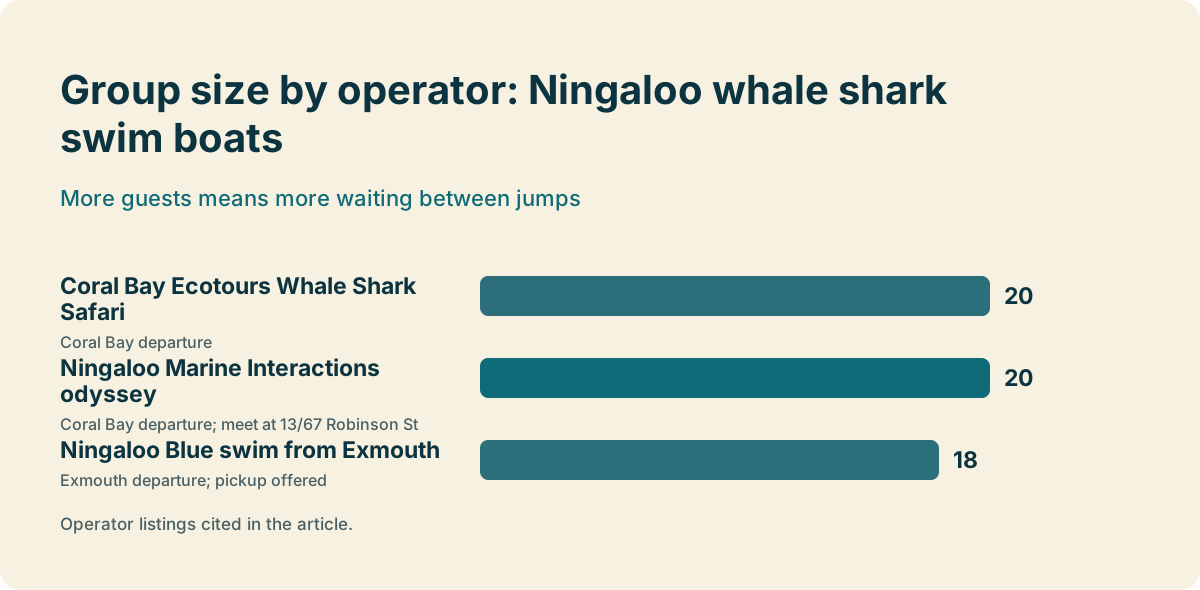
Group size on board is different from the group size in the water, and the roster shows the spread clearly. Coral Bay Ecotours' Whale Shark Safari takes up to 20 guests, meaning two full rotations per drop; the Ningaloo Marine Interactions odyssey also lists 20. Ningaloo Blue caps at 18 from Exmouth. More guests means more waiting between your jumps, which is the practical trade-off behind the otherwise similar prices.
The 60 Minute Cap And The Rules That Shape The Swim
Swimming with a whale shark at Ningaloo is capped at 60 minutes of interaction, with a maximum of ten swimmers in the water, minimum distances of 3 m from the head or body and 4 m from the tail, and a strict ban on touching, riding, flash photography, extension-pole cameras and motorised propulsion aids. Vessels get one shark at a time for a maximum of 90 minutes inside a 250 m approach zone at 6 knots or less.
Those numbers come from the legislated interaction protocols, and they do more than protect the shark; they define the texture of your swim. The 60 minute cap is a ceiling on total interaction time with a given animal, not a promise of an hour in the water, and in practice most guests experience the swim as several short jumps rather than one long float. The DBCA's Gujawari information guide, which uses the Traditional Owners' name for the whale shark, states the recreational rules plainly: cease if the animal shows stress, no scuba diving at all, and a 60 minute swimming limit. Commercial licensed tours work under equivalent licence conditions.
| Rule | Limit | Applies to |
|---|---|---|
| Swimmers in the water | Maximum 10 at one time | All swimmers |
| Distance from head or body | 3 m minimum | All swimmers |
| Distance from tail | 4 m minimum | All swimmers |
| Interaction time | 60 minutes maximum | Swimmers with a shark |
| Vessel contact | One vessel, 90 minutes max, 6 knots max | 250 m approach zone |
| Prohibited | Touching, riding, flash, pole cameras, motorised propulsion | Everyone |
It is worth being blunt about one thing these rules do not do: they do not guarantee a shark. Whale sharks are wild animals, the season statement from DBCA is March to July with operators running to August and sightings often extending to October, and no tour on this roster states a sighting guarantee or a free repeat trip. A quiet day is possible. The terms of each listing, including what happens if no shark is found, sit on the operator's booking page, and reading them before you pay is the single best use of five minutes of planning time. The guarantee question is examined in full elsewhere on this site.
Lunch, The Long Afternoon And The Sail Home
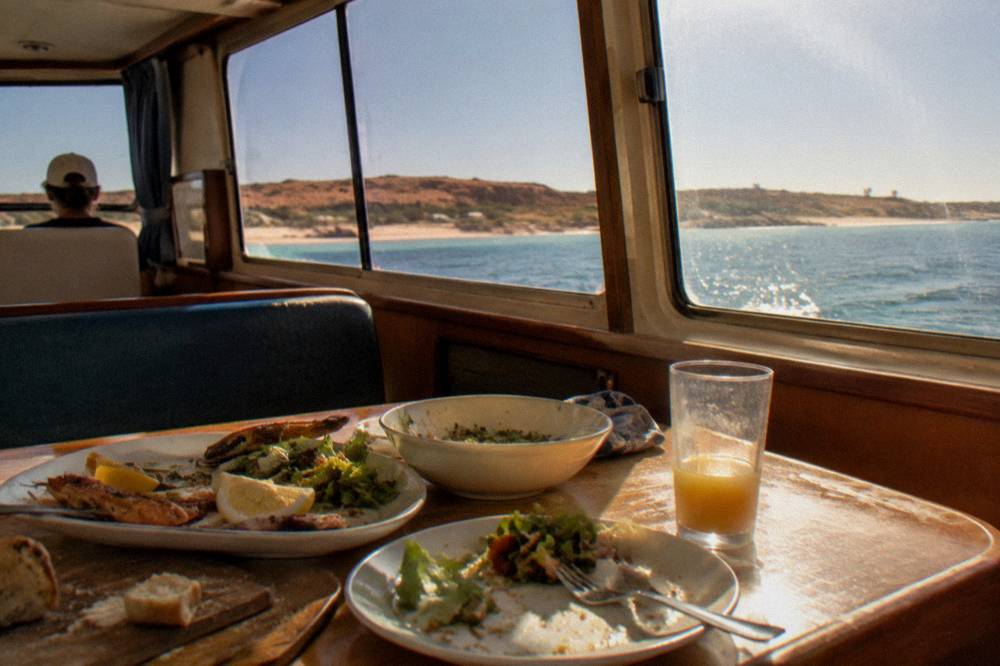
After the shark rotations finish, most tours serve a late lunch on board, often with time for another reef snorkel or a drift in the lagoon on the way back, and on longer Coral Bay days boats return to the ramp between about 4:00 and 5:00 pm, while Ningaloo Blue's Exmouth swim runs 6 to 7 hours. Catering is stated on most swim listings on this site, though a few state no meal, so it pays to check before assuming.
The late lunch is a structural feature, not an afterthought. The kitchens on these boats feed you around the shark schedule, which usually means the main meal lands after the swimming wraps, when the adrenaline has drained and the wind on the run home suddenly feels cold. On the roster, Coral Bay Ecotours' Whale Shark Safari, Ningaloo Blue's swim and the Ningaloo Marine Interactions odyssey all appear in the swim tier, with the odyssey the exception among the three in listing no meal, so pack or buy accordingly if that one is on your shortlist.
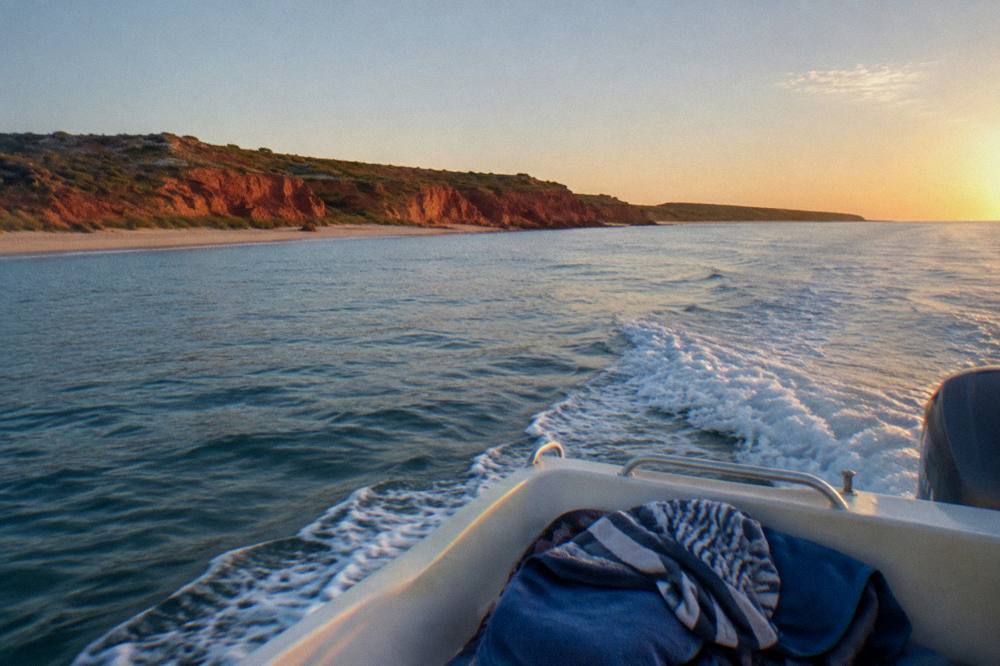
The afternoon run home is also when the day's other wildlife shows up. Humpbacks pass Ningaloo from June to November, and in the August shoulder, when whale shark tours are still running from Exmouth, the two seasons overlap on the water. Dugongs, dolphins and turtles are regular sightings on the reef legs. None of it is promised, the same way the shark is not, but the boat time is not dead time; it is the second half of what you paid for.
The nine-hour shape deserves emphasis because it drives almost every practical decision around the day. The Ningaloo Marine Interactions odyssey, from A$700 per person, runs about 9 hours from Coral Bay; Ningaloo Blue's swim, from A$705, is 6 to 7 hours from Exmouth; Coral Bay Ecotours' safari, from A$745, is 8 to 9 hours. Add pickup, briefing and the sail home and you are committing a full day, which is why questions like what to bring and seasickness are not footnotes: the open ocean outside the reef can be choppy, crews cannot refund a day lost to nausea, and the standard advice is to take medication in advance rather than on board.
Can You Swim With Whale Sharks In Ningaloo?
Yes, you can swim with whale sharks at Ningaloo, on a licensed commercial tour, between roughly March and July per DBCA, with operators running to August from Exmouth and sightings often extending to October. The 2025 season recorded 41,390 swims, and visitor numbers have grown from 1,000 in 1993 to over 36,000 in 2022. Independent swimming is possible in principle but a licensed tour is the practical route.
That growth is the context nobody puts on the postcard. Whale shark swimming at Ningaloo went from a thousand visitors in 1993 to over 36,000 in 2022, then past 41,000 swims in the 2025 season, per the regional tourism body. The fish, Gujawari to the Baiyungu, Thalanyji and Yinigurdira Traditional Owners, arrives because the March and April mass coral spawning, over 200 species spawning at once, triggers the plankton blooms it feeds on, with the Leeuwin and Ningaloo currents spinning the food into eddies along the reef.
For a recreational swimmer acting without a tour, the same protocol distances and prohibitions apply, along with the no scuba rule and the 60 minute limit. In practice the shark is found offshore and found from the air, which is why virtually everyone swims on a licensed day tour. Whether the experience justifies the price is a fair question with a personal answer, worked through in are whale shark tours worth it.
Which Tour Style Fits Your Day?
Choose by town and group size first: Exmouth departures such as the Ningaloo Blue swim run 6 to 7 hours with hotel pickup and 18 guests, while Coral Bay departures such as the Coral Bay Ecotours safari and the Ningaloo Marine Interactions odyssey run 8 to 9 hours with 20 guests and a town meeting point. Prices sit in a narrow band, from A$700 to A$745 per person, so the choice is really about logistics, not cost.
The narrow price band is the most useful fact on the whole comparison. With the three roster swims sitting between A$700 and A$745 per person, nobody is buying a bargain or a luxury tier; you are choosing a departure town, a group size, a duration and a cancellation policy. Ningaloo Blue's listing states the sale is final, non-refundable, while Coral Bay Ecotours and Ningaloo Marine Interactions both state free cancellation. That difference alone can decide the booking for anyone whose travel dates are not yet locked.
| Tour | From | Duration | Departs | Guests | Pickup |
|---|---|---|---|---|---|
| Ningaloo Blue swim | A$705 | 6 to 7 hours | Exmouth | 18 | Offered |
| Coral Bay Ecotours Whale Shark Safari | A$745 | 8 to 9 hours | Coral Bay | 20 | Not offered on the listing |
| Ningaloo Marine Interactions odyssey | A$700 | About 9 hours | Coral Bay | 20 | Not offered on the listing |
Ratings across the three are strong and, importantly, drawn from real pools: Ningaloo Blue holds 4.8 from 219 reviews, Coral Bay Ecotours 4.8 from 173, and the odyssey 5 from 23, a small pool stated plainly rather than dressed up. Where you stay shapes this choice more than anything else, since the two towns sit about 150 km and roughly 1.5 to 2 hours of driving apart; the Exmouth versus Coral Bay guide covers that split, and Australia's Coral Coast documents the season difference between them, March to June in Coral Bay, to August from Exmouth.
If the full-day, full-price swim is more day or more money than your trip allows, the reef alternatives are genuine rather than consolation options. Cape Immersion's six-hour boat snorkel from A$275 per person carries 12 guests with pickup from Exmouth and lunch stated on the listing, and the Ningaloo in a Day combo from Exmouth Adventure Co pairs reef snorkelling with the Yardie Creek cruise from A$320 per person in a group of eight. Neither puts a whale shark in the water beside you, and saying so plainly is the point: those are reef days, not shark days.
Common Questions About The Ningaloo Whale Shark Swim
Can You Swim With Whale Sharks In Ningaloo?
Yes. Licensed commercial tours run from both Exmouth and Coral Bay, with the season running March to July per DBCA and Exmouth operators running to August, sightings often to October. Swims happen in groups of up to ten with a guide, under a legislated interaction protocol.
How long are you actually in the water with the shark?
The legislated interaction cap is 60 minutes, but most guests experience the swim as several short jumps rather than one long float, with the boat resetting between groups of ten. Total in-water time beside the shark depends on how long it stays near the boat, up to a 90 minute vessel cap.
Do you have to be a strong swimmer?
You need to be able to swim and be confident in open water with a snorkel. Guides swim with each group, flotation support is standard on these tours, and the morning reef snorkels give crews a read on every swimmer before the shark drops begin.
What happens if no whale shark is found?
No tour on this roster states a sighting guarantee or free repeat trip, and whale sharks are wild animals. Check the terms on the operator's booking page before you pay; cancellation and no-sighting terms differ between listings.
Why is the day so long if the swims are so short?
Most of the day is finding the shark and making the most of the reef. Spotter aircraft search the outer reef while guests snorkel the inner reef, the boat may travel significant distances between contacts, and the catered lunch and homeward cruise fill the afternoon. A 6 to 9 hour boat day is standard.
Can you scuba dive with whale sharks at Ningaloo?
No. The official interaction rules prohibit scuba diving with whale sharks; all commercial swims are snorkel-based. The diving comparison, including diving the reef on separate trips, is covered in the scuba versus swim guide on this site.