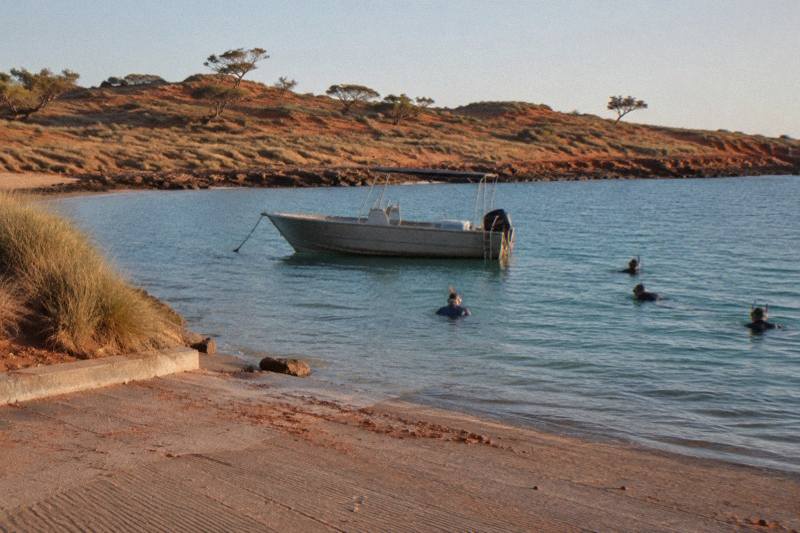
Ningaloo Whale Shark Swim Rules: What You Can And Cannot Do In The Water
Swimming with a whale shark at Ningaloo is regulated by a legislated interaction protocol, not just operator house rules. Here is exactly what the law allows, what your guide will ask of you, and what it means for the tour you book.
Short answer
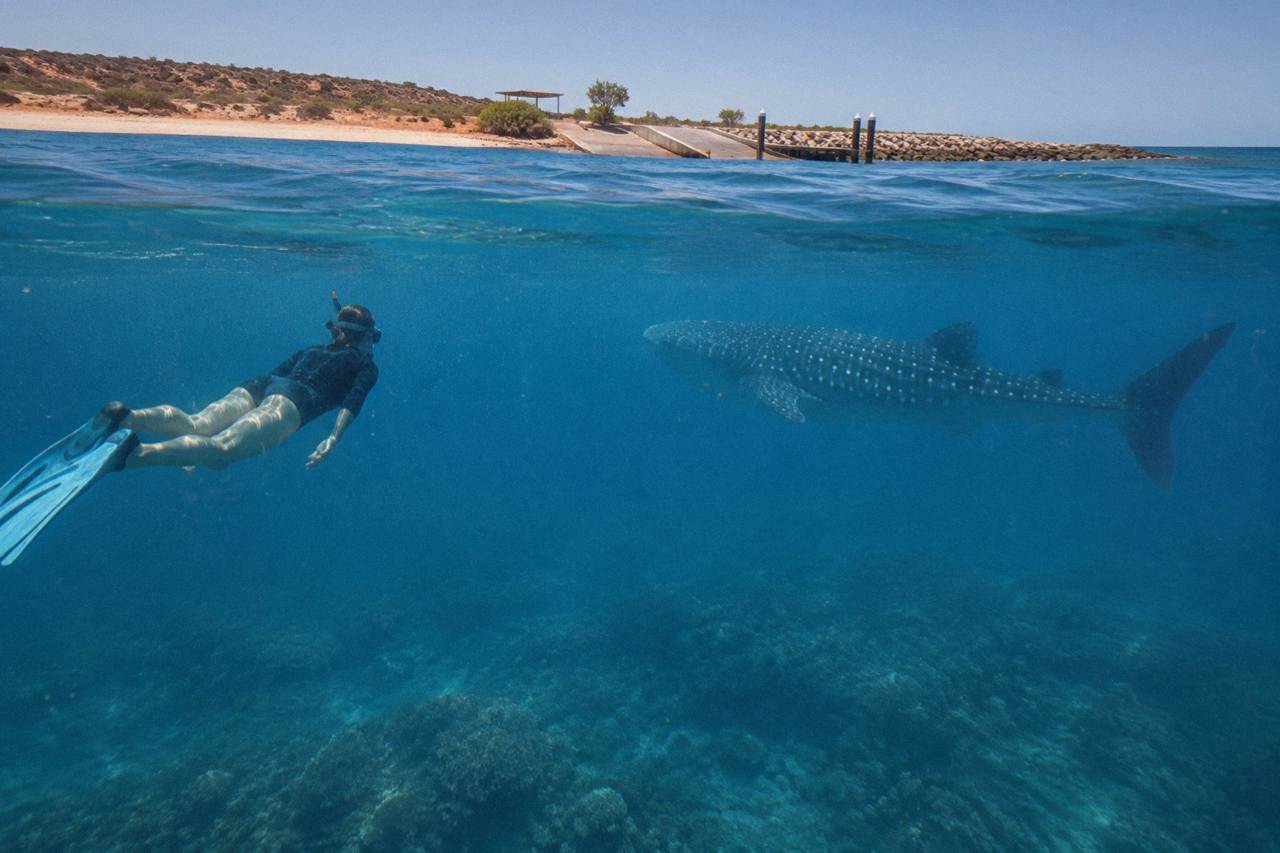
The rules are set by DBCA: stay at least 3 metres from a whale shark's head and body and 4 metres from its tail, never touch or ride the animal, no flash photography or extension-pole cameras, no motorised propulsion aids, a maximum of 10 swimmers in the water at one time, and a 60 minute cap on the interaction. Only licensed operators may run commercial swims.
Swimming with a whale shark off Exmouth or Coral Bay is not a free-for-all. It runs under a legislated interaction protocol written by the Department of Biodiversity, Conservation and Attractions (DBCA), the agency that manages Ningaloo Marine Park, and every commercial operator on the water holds a department licence that binds them to it. The Ningaloo Blue swim from Exmouth, the Coral Bay Ecotours safari and the Ningaloo Marine Interactions odyssey all work inside the same rulebook, which is worth understanding before you book, because several of the rules shape what your day actually looks like. The protocol covers distances, group sizes, time in the water, cameras, and how boats approach the shark in the first place. This guide sets out each rule plainly, explains the reasoning behind it, and answers the two questions swimmers ask most: why can't you touch a whale shark, and how long can you actually swim with one. If you also plan to swim from the shore under your own steam, our guide to Exmouth's beaches for swimming covers the currents, stingers and water temperatures at each spot.
What Are The Ningaloo Whale Shark Swim Rules?
The core rules are: keep 3 metres from the shark's head and body and 4 metres from its tail, never touch or ride the animal, never restrict its movement, no flash photography, no cameras on extension poles, no motorised propulsion aids, and no more than 10 people in the water with a shark at one time. Recreational swims are capped at 60 minutes, and only operators licensed by the department may run commercial whale shark tours in Ningaloo Marine Park.
These are not operator house rules that vary from boat to boat. They sit in two legislated interaction protocols published by DBCA, one for swimmers and one for vessels, and they apply across the whole marine park. The swimmer protocol is the one that matters to you on the day. Your guide will brief it before the first drop, and the crew will pull you out of the water if you breach it, because a breach can cost the operator its licence. The full protocol is published on the DBCA whale shark management page, which is the authoritative source for everything in this guide.
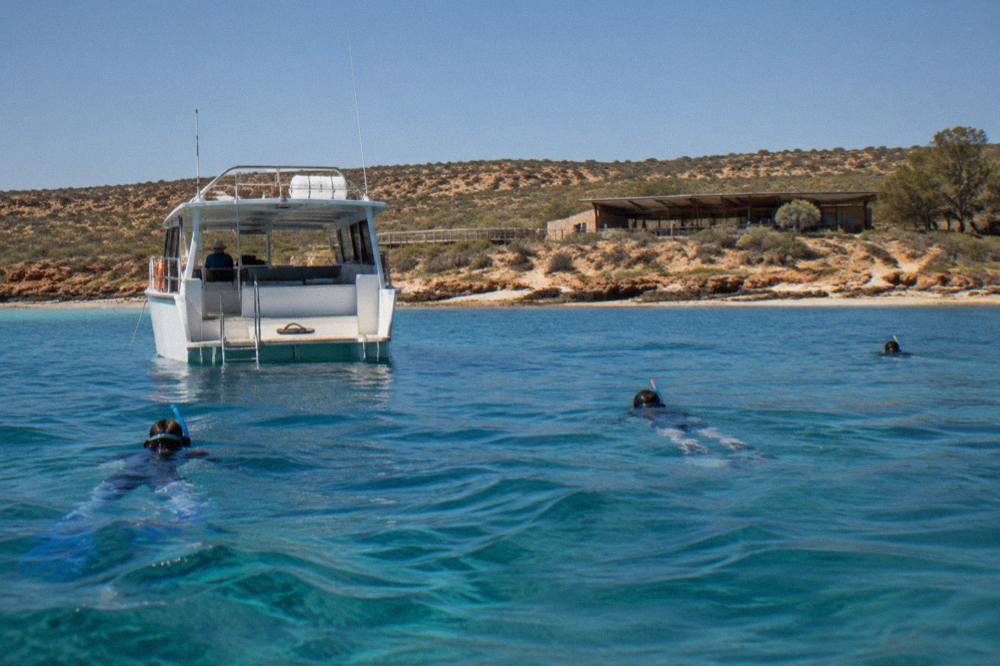
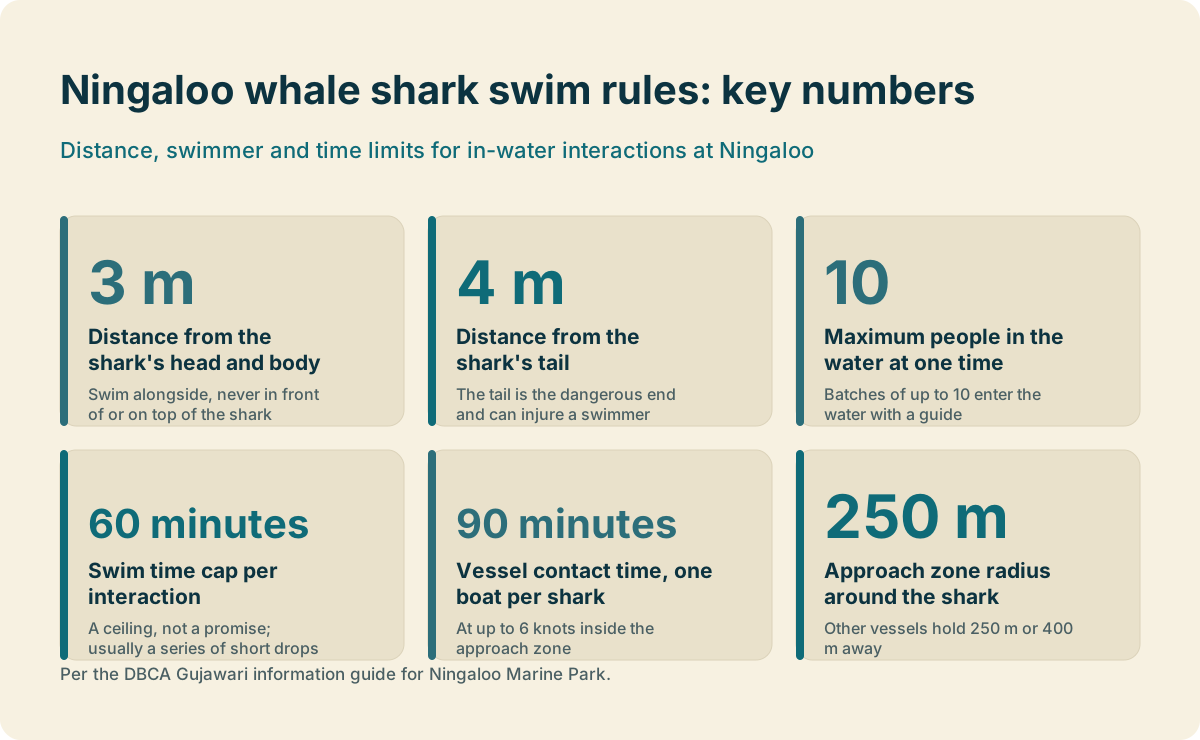
Here is the swimmer protocol in table form, exactly as DBCA states it.
| Rule | What it means in the water |
|---|---|
| 3 m from head and body | You swim alongside, never in front of or on top of the shark |
| 4 m from tail | The tail is the dangerous end: a whale shark tail can injure a swimmer |
| No touching or riding | Contact of any kind is prohibited, even incidental |
| No restricting movement | You cannot block, herd or cut off the shark's path |
| No flash photography | Ambient-light cameras only, flash off |
| No extension-pole cameras | Handheld cameras only, nothing on a stick |
| No motorised propulsion aids | Fins and your own swimming only |
| Maximum 10 swimmers | Groups enter in batches of up to 10 with a guide |
The rules exist for two reasons, and both matter. The first is animal welfare: whale sharks come to Ningaloo to feed on the plankton blooms that follow the March and April coral spawning, and the species is protected at state and national level. The second is you: a whale shark is the largest fish in the ocean, up to several tonnes of moving animal, and a swimmer who drifts too close to the tail is the one who gets hurt. The distances keep both parties safe.
Why Can't You Touch Whale Sharks At Ningaloo?
Touching a whale shark is prohibited because the species is specially protected in Western Australia and listed as vulnerable and migratory under national environment law, and because contact can harm the animal and change its behaviour. The DBCA protocol bans touching, riding or restricting a whale shark's movement, and a licensed operator that allows it risks its commercial licence, so guides enforce the rule firmly on every tour.
The legal layer is the short answer. Whale sharks are specially protected fauna in WA and appear on the national threatened species list as vulnerable and migratory, which puts any deliberate contact squarely inside offences that carry real penalties. But the practical layer is just as important. A whale shark's skin carries a mucus layer that protects it from infection and parasites, and human touch, sunscreen, rings and watches all abrade it. A shark that is repeatedly touched or crowded also changes its behaviour: it dives, or avoids boats altogether, which degrades the experience for every swimmer after you.
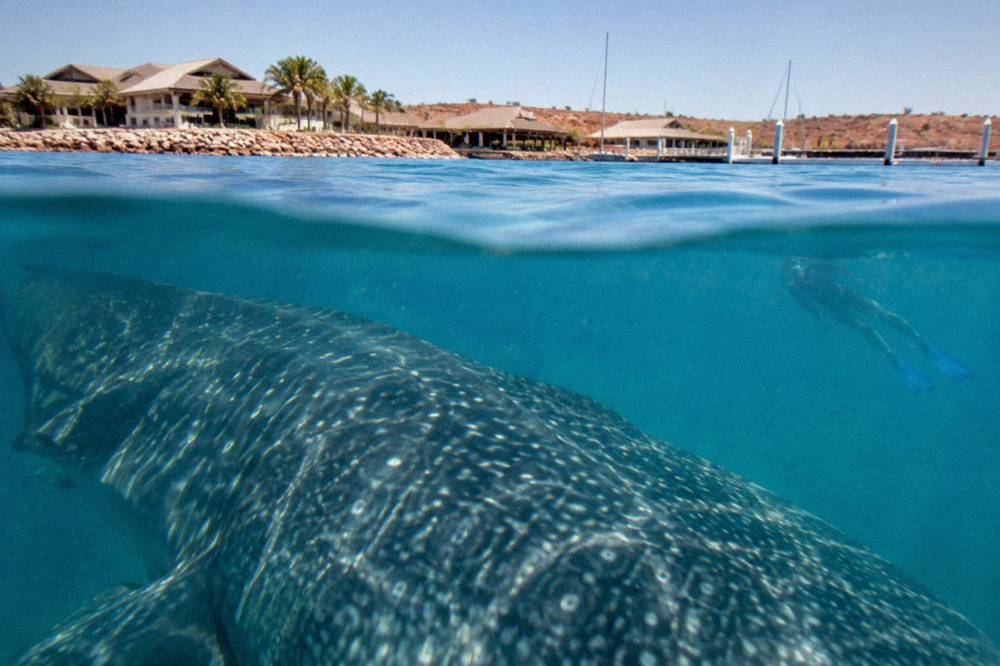
That is why the rule is written the way it is. The protocol does not just ban touching, it bans restricting the animal's normal movement or behaviour, which covers herding, blocking its path and chasing it from the front. Swimmers are dropped ahead of the shark's direction of travel so it swims past them on its own terms. If it chooses to approach, that is its decision; your job is to hold position in the water and let it pass. Guides from the Coral Bay Ecotours Whale Shark Safari through to the Exmouth-based Ningaloo Blue tour all brief this the same way, because it is the same law.
There is a common worry worth addressing: what if the shark comes to you? Whale sharks are curious and occasionally track along a line of swimmers. If one closes the distance itself, you are not in breach, but you still must not reach out. The standard instruction is to swim away gently or hold still and let the animal pass. The rule is about your conduct, not the shark's.
If you are still weighing whether a whale shark swim is safe for you generally, the guide to whether whale sharks are dangerous at Ningaloo covers behaviour, feeding and the actual risk profile in more depth.
How Long Can You Swim With Whale Sharks At Ningaloo?
A recreational whale shark interaction is capped at 60 minutes of swimming time with any one shark, per the DBCA Gujawari information guide for Ningaloo Marine Park. In practice most swimmers get a series of short drops rather than one long swim: you enter the water with your group of up to 10, swim with the shark until it moves off or the guide calls the batch, then reboard and repeat.
The 60 minute figure is a ceiling, not a promise of an hour in the water. A whale shark swims at a pace that a snorkeler can match for a while but not indefinitely, and each drop typically lasts a few minutes of hard finning before the shark pulls away or the guide rotates the next group in. Over a full tour day, which the regional tourism body describes as roughly 7:00 am to 4:00 or 5:00 pm, you may get several of these drops with the same animal or with different sharks as the spotter plane repositions the boat. The guide to what actually happens on a Ningaloo whale shark swim walks through that day shape in detail.
| Time element | The rule or reality |
|---|---|
| Total interaction cap | 60 minutes of swimming per interaction, per the official guide |
| Typical single drop | A few minutes of swimming before the shark moves off |
| Group rotation | Up to 10 swimmers per batch, rotated by the guide |
| Vessel contact time | One vessel per shark, maximum 90 minutes at up to 6 knots |
| Approach zone | 250 m radius around the shark; other vessels hold 250 m or 400 m away |
The vessel rules in that table are the ones you will notice least but that shape the day most. Only one boat is "in contact" with a shark at a time, inside a 250 metre approach zone, for up to 90 minutes. A second boat must stay 250 metres back and any others 400 metres. This is why licensed operators coordinate on the water and why your skipper may motor away from a shark another boat is already with: the law leaves no room for a scramble.
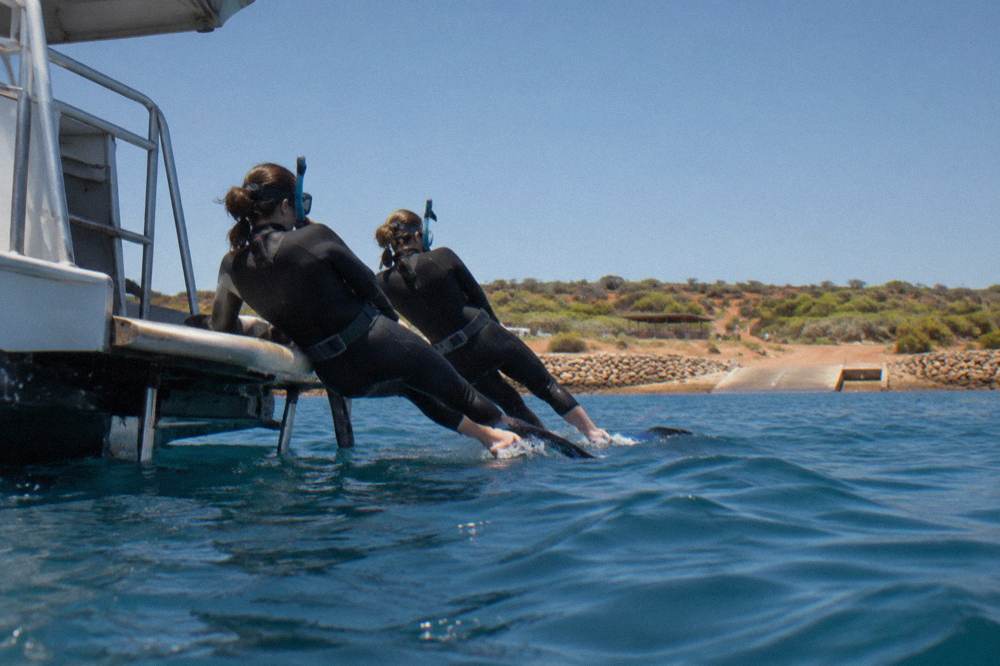
What Camera And Gear Rules Apply In The Water?
The protocol bans flash photography, cameras on extension poles and motorised propulsion aids, and it bans scuba diving with whale sharks entirely. Handheld, ambient-light cameras such as GoPros are generally permitted, but many operators restrict personal cameras during the swim itself, so check the listing before you pack one. Fins, mask and snorkel are standard, and operators supply wetsuits and flotation gear.
The camera rules trip up more swimmers than the distance rules, because people assume a GoPro on a short pole is fine. It is not: the protocol prohibits cameras on extension poles of any length, along with flash, because both disturb the animal at close range. Handheld cameras with the flash off are the baseline the law allows. From there it becomes operator policy: some crews are happy for you to bring your own, others restrict personal cameras during whale shark drops so swimmers concentrate on the guide's instructions rather than a viewfinder. The rule of thumb is to ask before the day, and to read the listing's inclusions, because photography arrangements differ between the Exmouth operators and the Coral Bay ones.
| Gear | Allowed under the protocol | Notes |
|---|---|---|
| Mask, snorkel, fins | Yes | Standard, usually supplied |
| Wetsuit and flotation vest | Yes | Supplied by the operator |
| Handheld camera, flash off | Yes | Confirm operator policy on personal cameras |
| Camera on a pole or stick | No | Banned outright |
| Flash photography | No | Banned outright |
| Scuba diving | No | Snorkel only, surface swimming |
| Motorised propulsion aids | No | Your own swimming only |
The scuba ban surprises divers. Whale shark swims at Ningaloo are surface-only: no bubbles from below, no chasing an animal down. It is one of the clearest differences between a whale shark swim and a dive trip, and the comparison of whale shark swims versus scuba diving at Exmouth covers it properly. If underwater photos are the priority, the guide to whale shark photography at Ningaloo explains what the rules let you capture and how operators handle photo packages.
How Many Swimmers Can Be In The Water At Once?
The protocol allows a maximum of 10 people in the water with a whale shark at one time, each batch accompanied by a guide. Boats carry more guests than that, typically up to 20, so the crew rotates groups: one batch swims while the rest watch from the vessel, then the next batch goes in. If you want fewer people in your batch, small-group listings exist and are worth comparing.
The 10 swimmer cap is legislated, not a comfort choice, and it is the number that most shapes the rhythm of your day. On a boat carrying 20 guests, you swim in two batches. On the Ningaloo Blue swim from Exmouth, the listing shows a group size of 18; on the Coral Bay Ecotours Whale Shark Safari and the Ningaloo Marine Interactions Whaleshark Odyssey, group size is 20. None of them can put more than 10 in the water at once, so every one of them runs a rotation. The rest of the planning pages sit on Whale Shark Tours Exmouth.
| Listing | Departs | Group size on board | Swimmers per batch |
|---|---|---|---|
| Ningaloo Blue Whale Shark Swim | Exmouth, hotel pickup offered | 18 | Up to 10, rotated |
| Coral Bay Ecotours Whale Shark Safari | Coral Bay, meet at the point | 20 | Up to 10, rotated |
| Ningaloo Marine Interactions Whaleshark Odyssey | Coral Bay, meet at the point | 20 | Up to 10, rotated |
If rotation sounds like a downside, it rarely is. Watching from the boat while the other batch swims is part of the experience, and it gives you a breather between drops. The guide in the water positions each batch ahead of the shark's path, calls the entry, and counts everyone back on board before the next group goes. The 10 person cap is also why the interaction feels orderly rather than crowded: even on a full boat, the water never holds more than 10 guests plus crew.
The Ningaloo Blue swim from Exmouth is the pick if hotel pickup matters to you: the listing states pickup is offered, and the tour runs 6 to 7 hours from Exmouth with a 4.8 rating from 219 reviews, from A$705 per person. One thing to note before booking: that listing states the sale is final and non-refundable, which is unusual on this roster, so check the terms on the live listing before you commit.
The Coral Bay Ecotours Whale Shark Safari takes the opposite approach to logistics: the listing does not offer pickup, guests meet at the departure point in Coral Bay, and the day runs 8 to 9 hours with a meal stated on the listing. It carries a 4.8 rating from 173 reviews, from A$745 per person, and the listing notes a park fee payable before departure, A$20 per adult and A$10 per child. Free cancellation applies.
Which Operators Can Legally Run Whale Shark Swims At Ningaloo?
Only operators licensed by DBCA may run commercial whale shark tours in Ningaloo Marine Park, and licensed vessels must display a whale shark flag and dive flags whenever swimmers are in the water. The licence binds the operator to the interaction protocol, so a licensed tour is by definition a rules-compliant tour. Booking through a licensed operator is the single simplest way to know your swim is legal.
This is the buyer's shortcut. You do not need to audit an operator's distances and time caps yourself, because the licence does that for you: a commercial whale shark licence comes with specific conditions attached, and breaches put it at risk. Every whale shark swim on this site's roster, from the Ningaloo Blue tour out of Exmouth to the Coral Bay Ecotours and Ningaloo Marine Interactions boats out of Coral Bay, is a licensed commercial product operating inside the protocol. The official Ningaloo Marine Park page confirms the park itself has no entry fee, so there is no separate visitor pass to arrange for the swim.
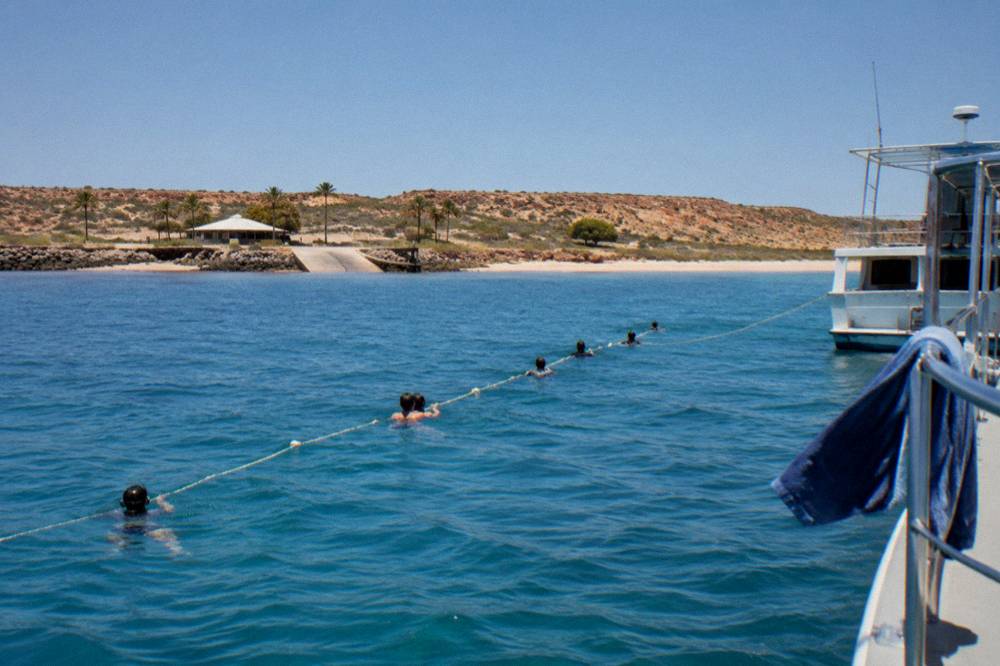
The flag requirement is more than decoration. When swimmers are in the water with a shark, the vessel shows both a whale shark flag and dive flags, which tells other boats, licensed or private, that a contact is happening and the 250 metre approach zone rules apply. Private vessels are bound by the same vessel protocol, which is one reason licensed tour boats and recreational boats coexist on the reef without chaos.
What Will The Guide Ask Of You On The Day?
Expect a rules briefing before the first drop, an assessment snorkel on the inner reef while the spotter plane searches, and clear instructions on each entry: swim hard when told, hold your line, keep the distances, and return to the boat when the guide calls. The protocol requires swimmers to be capable of open-water snorkelling, and crew can end an individual's swim for repeated breaches. None of it is onerous, but all of it is enforced.
The day typically opens with a practice snorkel inside the reef. The regional tourism body describes the standard pattern: leave accommodation around 7:00 am, two inner-reef snorkels while the spotter plane hunts, then the run outside the reef once a shark is found. That first snorkel is partly a swimmer assessment, and it is where a guide will quietly check that everyone can handle open water. If you are worried about fitness, the guide to whether you need to be a strong swimmer addresses it directly: you need confident snorkelling, not racing ability, and flotation support is standard.
| What the guide asks | Why the rule sits behind it |
|---|---|
| Enter only on the guide's call | Swimmers are dropped ahead of the shark's travel path |
| Swim alongside, never in front | 3 m from head and body; the shark must choose to pass |
| Keep clear of the tail | 4 m tail distance; the tail is the hazard |
| No reaching out, even if it approaches | No touching or restricting movement |
| Camera flash off, nothing on a pole | Flash and pole cameras are banned |
| Exit when the batch is called | 10 swimmer rotation and the 60 minute interaction cap |
Crews are generally patient with nervous swimmers and firm with careless ones. The distinction matters: a swimmer who struggles but follows instructions will get help and extra drops if the day allows; a swimmer who chases the shark or reaches for it will be pulled from the water, because the operator's licence is on the line. The rules are also why the experience stays consistent across operators. Whether you swim from the Ningaloo Marine Interactions Whaleshark Odyssey, a 9 hour Coral Bay day with a 5 rating from 23 reviews from A$700 per person, or from an Exmouth boat, the protocol in the water is identical.
One honest caveat belongs here. Whale sharks are wild animals and no listing on this roster promises a sighting or a repeat trip if the day is quiet. The rules, the spotter planes and the licensed crews together give the season its reliability, but the truth to hold onto when booking is that every tour runs on the animal's terms. Check the cancellation and terms section of whichever listing you choose, because they differ: most roster whale shark swims offer free cancellation, while the Ningaloo Blue listing states the sale is final.
Where Do The Rules Leave You As A Buyer?
As a buyer, the rules tell you three useful things: any licensed tour you book is legally bound to the same protocol, so the choice between operators comes down to logistics, price and group size rather than rule differences; the distances and rotation are fixed, so no listing can promise a closer or longer swim; and the terms that do vary, cancellation, pickup, meals and extras, are the parts worth comparing on the listings.
That reframes the shopping task. The swim itself is standardised by law. What differs across the roster is the wrapper around it: where the boat leaves from, whether pickup is offered, how long the day runs, what food is listed, and what the cancellation terms say. The comparison of the best whale shark tours from Exmouth works through those differences listing by listing, and the Exmouth versus Coral Bay whale shark comparison covers the two departure towns, roughly 150 km and under two hours' drive apart.
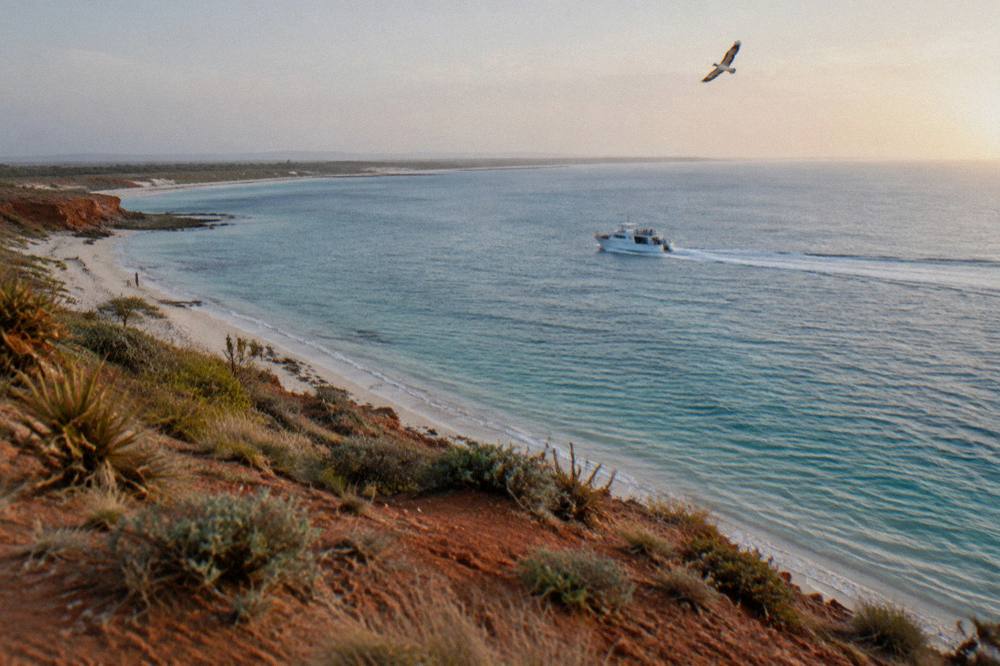
The season window is the other planning fact. DBCA states whale sharks visit between March and July, while operators and the regional tourism body show Exmouth tours running to August, Coral Bay to the end of June, and sightings often extending to October, with Exmouth tours meeting sharks as late as early November in 2024 and 2025. The guide to the whale shark season at Exmouth has the full month-by-month picture. Whenever you go, the interaction rules do not change, and neither does the honest framing this site applies to every listing: wild animals, no guarantees, and a protocol that keeps the encounter safe for both sides. The Australia's Coral Coast whale shark page is the regional tourism body's own summary if you want a second official read.
Common Questions About Ningaloo Whale Shark Swim Rules
Why can't you touch whale sharks?
Whale sharks are specially protected in Western Australia and listed as vulnerable and migratory under national law, and the DBCA interaction protocol prohibits touching, riding or restricting them. Contact damages the protective mucus layer on their skin and can alter their behaviour around boats and swimmers. A licensed operator that allowed touching would risk its commercial licence, so guides enforce the rule on every tour.
How long can you swim with whale sharks at Ningaloo?
The official cap is 60 minutes of swimming time per interaction. In practice you swim in short drops: your batch of up to 10 enters with a guide, swims alongside the shark until it moves off or the guide rotates the group, then reboards. Over a full tour day you may get several drops with the same shark or with different animals.
How close can you get to a whale shark at Ningaloo?
The protocol requires swimmers to stay at least 3 metres from the shark's head and body and 4 metres from its tail. If the shark closes the distance itself, you are not in breach, but you must still not reach out or block its path. Boats must stay at least 30 metres from a shark and approach from ahead of its direction of travel when dropping swimmers.
Can you use a GoPro when swimming with whale sharks?
Handheld cameras with the flash off are the baseline the protocol allows, while flash photography, cameras on extension poles and scuba diving are all banned. Many operators further restrict personal cameras during whale shark drops, so check the listing or ask the operator before the day. Photography arrangements vary between Exmouth and Coral Bay operators.
How many people can swim with a whale shark at once?
A maximum of 10 people may be in the water with a whale shark at one time, accompanied by a guide. Tour boats carry more guests than that, typically 18 to 20 on the roster's whale shark listings, so the crew rotates batches while the rest of the group watches from the vessel.
Do the rules mean a licensed tour is guaranteed to see a whale shark?
No. The rules govern how an interaction is conducted, not whether one happens. Whale sharks are wild animals, no listing on this site promises a sighting or a repeat trip, and the only stated sighting policy on the roster is the manta cruise listing, which says sightings are not guaranteed. Check each listing's own terms before booking.